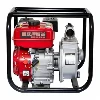
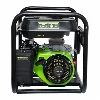
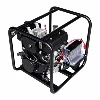
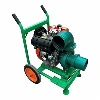
A water pump is a device that converts mechanical energy-or other forms of energy-into the kinetic and pressure energy of a liquid; it is widely used in fields such as agricultural irrigation, landscaping, industrial water supply, drainage, and plant protection equipment. Although there are many types of water pumps, their core components typically include the pump casing, impeller, pump shaft, bearings, sealing mechanism, and inlet and outlet ports. Specific structural designs vary by type; for instance, centrifugal pumps primarily rely on the high-speed rotation of an impeller to transport liquid, whereas plunger pumps and diaphragm pumps achieve liquid transfer through reciprocating motion.
The pump casing serves as the main housing, enclosing and protecting internal components while forming the flow path for the liquid. It is equipped with inlet and outlet ports; liquid enters the pump chamber through the inlet, gains energy from the internal mechanical components, and is subsequently discharged through the outlet. The casing must possess adequate strength and corrosion resistance-requirements that become even more stringent when handling liquids containing impurities or corrosive substances. The impeller is a critical working component in centrifugal pumps; by rotating, it generates centrifugal force that imparts velocity and pressure to the liquid, thereby enabling continuous flow.
The pump shaft is responsible for transmitting mechanical energy from the power source to the impeller, driving it to rotate at the specified direction and speed. To ensure stability and prevent bending or breakage during long-term operation, the shaft requires high strength, rigidity, and corrosion resistance. Bearings support the shaft, minimizing friction during rotation and ensuring stable operation. Insufficient lubrication or bearing wear can lead to abnormal noise and vibration during operation, necessitating regular inspection and maintenance.
The sealing mechanism is another vital component, serving to prevent liquid leakage through the gap between the shaft and the casing while also keeping air out of the pump chamber. Common sealing methods include mechanical seals and gland packing. As seals are prone to wear, timely inspection and replacement are required if significant leakage occurs after prolonged use. In addition, water pumps may be equipped with auxiliary components such as couplings, baseplates, filtration devices, valves, and pressure gauges; these facilitate the connection to the power source and optimize intake, discharge, and operational control.
The core components of a water pump work in concert to transport liquid. The power source supplies mechanical energy, the pump shaft transmits this power, the impeller (or other working mechanism) performs work on the fluid, and the pump casing forms the flow passages, while bearings and sealing systems ensure stable and reliable operation. As structural designs and materials vary depending on the application, selecting and maintaining a pump requires a comprehensive assessment of factors such as flow rate, head, fluid properties, operating environment, and power requirements to ensure optimal efficiency and service life.